
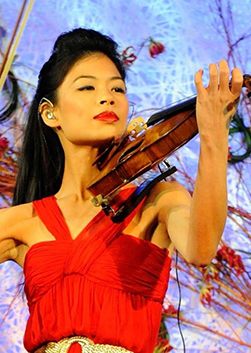
Vanessa Mae’s net worth is estimated at roughly $40 million in 2026, with some outlets putting the figure as high as $45 million. The Singapore-born British violinist built that fortune the hard way: by selling several million records, touring relentlessly for three decades, and inventing a pop-classical hybrid she calls “violin techno-acoustic fusion” that no one else was doing when she broke through in the mid-1990s. By 2006 she was reportedly the wealthiest UK entertainer under the age of 30.
Net worth headlines only tell part of the story, though. Vanessa Mae’s career is a genuinely strange and interesting one — child prodigy, chart-topping crossover star, lightning rod for classical purists, and, briefly, an Olympic alpine skier caught in a race-fixing scandal. Here’s where the money actually comes from, and how she got here.
Vanessa Mae’s net worth at a glance
| Detail | Information |
|---|---|
| Estimated net worth (2026) | ~$40 million (estimates range $40–45M) |
| Full name | Vanessa-Mae Vanakorn Nicholson |
| Born | 27 October 1978, Singapore |
| Nationality | British (Singaporean-born, Thai paternal heritage) |
| Primary income sources | Album sales, concert tours, classical and crossover recordings |
| Breakthrough album | The Violin Player (1995) |
| Best-known for | “Techno-acoustic fusion” — electric violin crossover |
Net worth figures for any celebrity are outside estimates, not audited accounts. Treat the $40 million number as a well-sourced ballpark rather than a precise balance sheet.
How much is Vanessa Mae worth?
Most major net-worth trackers, including Celebrity Net Worth, land on an estimate of around $40 million. That puts her among the wealthier classical-crossover musicians of her generation, and it’s a figure she reached early — at the height of her recording career in the 2000s she was already described as Britain’s richest entertainer under 30.
The variation between sources (you’ll see anything from $40M to $45M) is normal. These numbers are reverse-engineered from public information about record sales, tour activity, and known assets, so they drift depending on who’s counting and when. What’s not in dispute is that the bulk of the money was made during a remarkably concentrated stretch of hit albums in the mid-to-late 1990s.
How Vanessa Mae made her money
Her wealth rests on three pillars, and they reinforce each other.
- Record sales. The Violin Player, released in 1995 when she was 16, sold in the millions and charted in more than 20 countries. Follow-up albums kept the momentum going through the late 1990s and early 2000s. Cumulative sales running into the millions of copies are the foundation of the fortune.
- Touring. A crossover act that fills concert halls and arenas earns far more from ticketed live shows than from recordings alone. Vanessa Mae has toured internationally for decades, and live performance has remained her most durable income stream as physical record sales declined industry-wide.
- The crossover formula itself. By marrying classical repertoire to dance and rock production, she opened up a pop audience that traditional violinists never reach. That commercial positioning — not just talent — is what turned a gifted player into a high-earning brand.
It’s worth being clear-eyed about one thing: she has not released a major new studio album in well over a decade, so the catalogue and the touring schedule, rather than new releases, drive her earnings today.
From Singapore to the Royal College of Music
She was born Vanessa-Mae Vanakorn on 27 October 1978 in Singapore, to a Singaporean mother of Chinese descent, Pamela Soei Luang Tan, and a Thai father, Vorapong Vanakorn. Her parents separated when she was young, and after her mother married British lawyer Graham Nicholson, the family moved to London. Vanessa was about four.
Music came almost absurdly early. She started on piano at three and switched her main focus to the violin around age five. Her mother — a capable pianist herself — drove the training hard, and Vanessa later studied with Felix Andrievsky at the Royal College of Music in London, as well as spending time under Lin Yao Ji at the Central Conservatory in Beijing.
Her professional international debut came in 1988 at the Schleswig-Holstein Music Festival in Germany, when she was 10. Records started falling soon after: Guinness World Records recognised her as the youngest soloist to record both the Beethoven and Tchaikovsky violin concertos, a feat she pulled off at just 13.
That intense, controlled upbringing left marks. In later interviews she described an isolated adolescence — constant practice, minders, little contact with friends her own age — and her relationship with her mother, who also acted as her manager, eventually broke down. When Vanessa came of age she parted ways with her mother professionally, and the two became estranged.
The Violin Player and the crossover breakthrough
Around age 14 she picked up the electric violin, and the move reshaped her career. In 1995, The Violin Player turned a classically trained prodigy into a genuine pop star. Tracks like “Toccata and Fugue” reframed Bach for a dance audience, and the album’s sound — what she branded “techno-acoustic fusion” — was unlike anything on the classical shelves.
The commercial payoff was huge. The record sold millions worldwide and charted across dozens of countries, and in 1996 she was named Best-Selling Classical Artist at the BRIT Awards. She followed it with albums that leaned into her heritage and her range, including Storm in 1997, where she added her own vocals alongside the violin.
For the curious, her catalogue is well documented on her Wikipedia page and discography, which trace the shifts between her pop-crossover releases and her more straightforwardly classical recordings.
Acclaim, criticism, and an asteroid
Success at that scale, in a tradition-bound field, guaranteed a backlash. Some classical figures dismissed her as a marketing creation who sold the violin on image rather than artistry. She heard the criticism and largely brushed it off, arguing in interviews that she never altered a single note of the classical works she performed — she changed the sound and the presentation, not the music — and that her goal was to pull the violin into popular culture the way electric pioneers did for the guitar.
The flip side of the criticism is real reach. Plenty of listeners encountered Vivaldi or Bach for the first time through her recordings, which is not a small thing. And the recognition went literally cosmic: asteroid 10313 Vanessa-Mae, discovered in 1990, was named in her honour.
The skiing detour and the Sochi scandal
Skiing was Vanessa Mae’s lifelong escape from the practice room, and in 2014 it produced the most bizarre chapter of her career. Competing for Thailand under her father’s surname as Vanessa Vanakorn, she entered the giant slalom at the Sochi Winter Olympics and finished 67th — dead last among the finishers, and well off the pace, but an Olympian nonetheless.
The story didn’t end there. The International Ski Federation (FIS) later found that the qualifying races that got her to Sochi — organised at the request of her management — had been manipulated, and in November 2014 it banned her for four years. She called the ruling “nonsense” and appealed.
The Court of Arbitration for Sport sided with her in 2015, annulling the four-year ban and finding that Vanessa Mae herself was not guilty of manipulation. The catch: CAS also confirmed she had not actually been eligible to compete at Sochi. So she keeps her name cleared, but the Olympic result sits under an asterisk.
Vanessa Mae’s personal life
For years Vanessa Mae’s long-term partner has been Frenchman Lionel Catalan, a wine merchant. The two have been together since the late 1990s. She has been candid that marriage isn’t a goal for her — having watched her own family go through divorce, she’s said more than once that you don’t need a ring to prove a commitment.
Away from music she’s an avid skier and dog owner, and she has spent time living between the UK and the Swiss Alps, where the skiing she loves is on her doorstep.
What is Vanessa Mae doing now?
Now in her late 40s, Vanessa Mae continues to perform live rather than chase new studio releases. Her last burst of new material came in the 2000s, and since then her income and public profile have rested on touring, her substantial back catalogue, and occasional appearances. She remains one of the most recognisable crossover violinists in the world — and, on the strength of that catalogue and decades on the road, comfortably one of the wealthiest.
Frequently asked questions
What is Vanessa Mae’s net worth in 2026?
Her net worth is estimated at around $40 million, with some sources citing up to $45 million. The figure is an outside estimate based on record sales, touring, and known assets rather than a confirmed accounting.
How did Vanessa Mae get rich?
Primarily through music: multi-million-selling albums led by 1995’s The Violin Player, decades of international touring, and her commercially successful classical-pop crossover style. She was reportedly Britain’s wealthiest entertainer under 30 by 2006.
Why is her name spelled “Vanessa May” sometimes?
“May” is a common phonetic misspelling. Her professional name is Vanessa-Mae, and her full name is Vanessa-Mae Vanakorn Nicholson.
Did Vanessa Mae really compete in the Olympics?
Yes. She skied the giant slalom for Thailand at the 2014 Sochi Winter Olympics, finishing 67th. She was later cleared by the Court of Arbitration for Sport of any wrongdoing in the qualifying scandal, though CAS confirmed she had not been eligible to compete.
Is Vanessa Mae still making music?
She still performs live but has not released a major new studio album in many years. Touring and her catalogue, rather than new recordings, sustain her career today.