
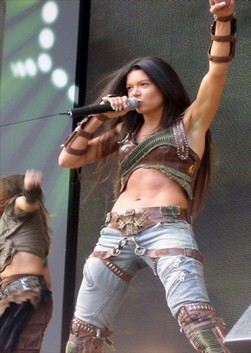
Ruslana Stepanivna Lyzhychko is a Ukrainian singer, songwriter, producer, and human rights activist who became the first Ukrainian act — and the first artist from any former Soviet country — to win the Eurovision Song Contest. Her 2004 victory with “Wild Dances” turned her into a European pop phenomenon virtually overnight. In the two decades since, she has built a parallel career as one of Ukraine’s most visible political voices: spending over 100 nights on the Maidan stage during the 2013–2014 Revolution of Dignity and traveling the world after Russia’s 2022 full-scale invasion to rally international support for her country.
Ruslana Lyzhychko Net Worth
Ruslana Lyzhychko’s net worth is estimated at approximately $2 million, with figures across various entertainment tracking sources ranging from $1 million to $5 million. Her income draws from several streams: album and single sales, live concert revenue, production work through her Luxen Studio label, television appearances, and a busy international advocacy schedule that keeps her profile high with global audiences. The commercial foundation of her wealth is the Wild Dances era — the album sold over 500,000 copies in Ukraine alone and the title single charted for 97 weeks across European markets. She continues to record and tour; new singles in 2024 and 2025 and a performance at the Eurovision Song Contest 2026 final in Vienna confirm she remains an active artist rather than a legacy act living off royalties.
Early Life and Family Background
Ruslana was born on 24 May 1973 in Lviv, then part of the Ukrainian Soviet Socialist Republic. Her mother, Nina Arkadievna, worked as an engineer at the Lviv Petrochemical Institute before eventually transitioning into the entertainment industry — she now manages media operations at her daughter’s production company, Luxen Studio. Her father, Stepan Ivanovich, also worked at the institute as a heat engineer before moving into business. Her parents divorced in 1981. She has one sister, Anna.
The Hutsul heritage on her father’s side — the Hutsuls are an ethnic Ukrainian mountain people from the Carpathian region — would later shape the entire sound and visual identity of her most successful work.
Education and Early Career
Ruslana’s mother enrolled her in music school early, and she was performing as a vocalist with youth groups — “Horizon,” “Orion,” and the children’s ensemble “Smile” — well before finishing secondary education at the 52nd school in Lviv. She went on to study at the Lviv Conservatory and graduated in 1995 with qualifications in classical piano and symphony orchestra conducting.
Her professional momentum started immediately after graduation. In 1996 she won the prestigious Slavianski Bazaar festival and picked up a Ukrainian nomination for Singer of the Year; her video for “Dzvinky Veter” (Ringing Wind) earned a Best Video nomination alongside it. That same year she married music producer Alexander Ksenofontov, who would co-write songs for her and steer the early stages of her recording career.
In 1997 she created “Christmas with Ruslana,” a TV project that became the first Christmas television special produced in Lviv. Her debut studio album, Dzvinky Viter (Sounding Wind), followed in 1998 — the song “Svitanok” from that record won Best Song of the Year at the Golden Firebird festival. A Christmas album, Stop Rizdvo 90s (Last Christmas of the 90s), arrived in 1999.
Wild Dances: The Album That Changed Everything
Ruslana’s Hutsul roots gave her a creative direction that nobody else in Ukrainian pop was taking. Through the late 1990s and early 2000s she worked on weaving Carpathian folk melodies and traditional Ukrainian instruments into a contemporary dance-pop framework — something that sounded distinctly Ukrainian and immediately accessible to a European pop audience at the same time.
That experiment paid off decisively in 2003 with the release of Dyki Tantsi (Wild Dances). The album went multiple-platinum in Ukraine and sold more than 500,000 copies domestically, making it the best-selling Ukrainian album of all time. An English-language edition followed in 2004, aimed squarely at international listeners, and earned a Best Foreign Album award in Romania as well as a nomination for a similar honor in Hungary.
Eurovision 2004: Ukraine’s Historic Victory
Ukraine’s national broadcaster selected Ruslana to represent the country at the Eurovision Song Contest 2004 in Istanbul. She performed “Wild Dances” — a track she had co-written — and won the contest with 280 points, the highest total of the night. It was Ukraine’s first-ever Eurovision win and the first time any former Soviet country had taken the contest.
The win triggered an extended run across European charts. “Wild Dances” spent 97 weeks in various European singles charts and hit number one in Belgium for ten consecutive weeks — placing it among the longest-running Belgian number-one singles on record. The song was certified gold in Belgium, Sweden, Russia, Greece, the Czech Republic, and Slovakia. Ruslana also received the World Music Award that year as the best-selling Ukrainian artist.
The Ukrainian government awarded her the title of People’s Artist of Ukraine following the Eurovision win. The United Nations appointed her UNICEF Goodwill Ambassador for Ukraine, a position she held through 2005. As the defending champion, she opened Eurovision 2005 in Kyiv with “Heart on Fire” and performed a second new song, “The Same Star,” as an invited guest. The following year, German television viewers voted “Wild Dances” the best Eurovision entry in the contest’s history.
Music Career After Eurovision
Two new studio albums landed in 2008: Amazon, her Ukrainian-language release, and Wild Energy, an English-language record distributed globally that featured collaborations with American artists Missy Elliott and T-Pain. That same year she lent her voice to the in-game radio station Vladivostok FM in Rockstar’s Grand Theft Auto IV — the station plays Eastern European pop, and the Ukrainian version of “Wild Dances” was among its tracks. She also voiced characters in the Ukrainian dubbing of the 2009 animated film Alice’s Birthday.
In May 2011 she served as a guest coach on the Ukrainian singing competition Voice of the Country on Channel 1+1, selecting and mentoring a team of 14 contestants alongside coaches Stas Piekha and Diana Arbenina.
Music releases have continued through the war years. A new single, “Miy Brat! Razom” (My Brother! Together), arrived in 2024, followed by “BUYNA/IRON BEAT” in 2025. She performed at the Eurovision Song Contest 2026 final in Vienna and headlined a Ukrainian solidarity rally at London’s Trafalgar Square in February 2026, the fourth anniversary of Russia’s full-scale invasion.
Political Career and the Orange Revolution
Ruslana has never treated politics as a sideline to her performing career. During the Orange Revolution of 2004–2005 she used her freshly won Eurovision platform to publicly back Viktor Yushchenko’s presidential campaign, amplifying the opposition movement at a moment when her name carried genuine weight across Europe. In 2006 she was elected as a People’s Deputy of the Verkhovna Rada on the Our Ukraine party list. She resigned the mandate not long after, saying that parliamentary mechanics were less suited to the kind of direct public advocacy she found more effective.
The Maidan: 100 Nights on the Stage
The most defining chapter of Ruslana’s public life beyond music came during the Euromaidan protests of 2013–2014. When demonstrations erupted in November 2013 after the government abruptly refused to sign an EU association agreement, she was on the Maidan Nezalezhnosti stage within the first days — and she stayed.
By her own account and contemporaneous reporting, she spent at least 100 days and 100 nights on the Maidan stage through the bitter Kyiv winter, singing the national anthem, giving speeches, and working to keep crowds peaceful during moments of escalating violence. On the night of 30 November 2013, when riot police moved in to clear sleeping protesters, she helped lead roughly 100 students — some of them injured — to shelter in a nearby monastery. She received death threats and was warned she was a target for snipers; she did not leave.
In March 2014 the U.S. Department of State awarded her the International Women of Courage Award for her role in the Revolution of Dignity. Forbes named her one of the ten most influential women of 2013 for the same reason.
Advocacy During Russia’s Full-Scale Invasion (2022–Present)
When Russia launched its full-scale invasion on 24 February 2022, Ruslana moved immediately into wartime advocacy. On 7 March 2022 she released “I’m Alive,” a song dedicated to Ukrainian civilians and soldiers killed in the war. The international schedule that followed was relentless: in May 2022 she traveled to Istanbul to lobby Turkish President Erdoğan on Ukraine’s behalf, appearing alongside the mothers of soldiers who had defended the Azovstal steelworks in Mariupol. In September 2022 she joined daily vigils outside the White House in Washington, D.C., demanding sustained American support. In November 2022 she led a protest in Athens that merged with a demonstration for women’s rights in Iran.
In August 2023 she headlined a concert at Tallinn’s Freedom Square marking both Ukrainian Independence Day and Estonia’s restoration of independence, with proceeds going toward bomb shelters and support for children near Ukraine’s frontlines. Ahead of Eurovision 2023 in Liverpool she announced a new studio album intended to show that Ukraine’s creative life had not stopped. “Music has become quite the weapon during this time of war,” she said that September — meaning it keeps morale intact as much as it draws attention abroad.
She has called publicly for increased Western military aid and for the end of Putin’s government, positions that have brought documented personal threats from Russian-aligned sources.
Frequently Asked Questions
What is Ruslana Lyzhychko’s net worth?
Ruslana Lyzhychko’s net worth is estimated at around $2 million, based on her music catalog, album and single sales, concert income, and her Luxen Studio production business. Estimates across different sources range from $1 million to $5 million. She remains actively earning through new recordings and touring.
Did Ruslana Lyzhychko win Eurovision?
Yes. Ruslana represented Ukraine at the Eurovision Song Contest 2004 in Istanbul and won with “Wild Dances,” scoring 280 points — the highest total of the competition. It was Ukraine’s first Eurovision win and the first by any artist from a former Soviet country.
Is Ruslana Lyzhychko still making music?
Yes. She released singles in 2024 (“Miy Brat! Razom”) and 2025 (“BUYNA/IRON BEAT”) and performed at the Eurovision Song Contest 2026 final in Vienna. She also continues to tour and perform internationally.
What did Ruslana Lyzhychko do during the Maidan protests?
Ruslana spent more than 100 days and nights on the Maidan stage in Kyiv during the 2013–2014 Revolution of Dignity, singing, speaking, and helping to protect protesters despite death threats. The U.S. State Department gave her the International Women of Courage Award in 2014 for this role, and Forbes named her one of the world’s ten most influential women of 2013.
Who is Ruslana Lyzhychko married to?
Ruslana married music producer Alexander Ksenofontov in December 1995. Ksenofontov has produced her work and co-written songs for her throughout her career.