
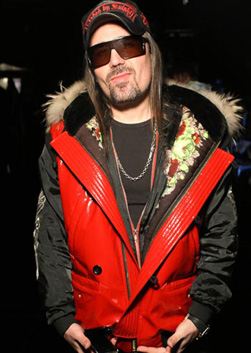
Bogdan Titomir is the man who brought hip-hop to the Soviet Union before most Russians even had a word for it. In 1989, when rap was still a novelty in Moscow, he and Sergey Lemokh formed Car-Man and filled stadiums. He went solo, sold millions of records through the 1990s, survived a turbulent self-imposed exile in America, and has been performing — controversially and relentlessly — ever since. His estimated net worth sits at approximately $5 million, built across more than three decades in music, production, club management, and television.
Quick Facts: Bogdan Titomir
| Real name | Oleg Petrovich Titorenko |
| Date of birth | March 16, 1967 |
| Place of birth | Odessa, Ukrainian SSR (now Ukraine) |
| Nationality | Russian |
| Profession | Rapper, singer, DJ, producer, TV host |
| Known for | Car-Man duo; pioneering Russian hip-hop; “Do as I Do” |
| Active | 1989–present |
| Estimated net worth | ~$5 million (unverified) |
Early Life and Childhood
Bogdan Titomir was born Oleg Titorenko on March 16, 1967, in Odessa. His father Pyotr was a construction engineer; his mother Zinaida worked as an economist-programmer. The family moved several times across Soviet Ukraine — from Odessa to Severodonetsk, then to Kharkov, and finally to Sumy, where Bogdan attended School No. 7.
Life at home was difficult. His father drank heavily, and the marriage eventually fell apart under the strain. Titomir has spoken about it without bitterness: “My father was close friends with alcohol — so I had seen enough. The parents separated because of this. My father ran into my mother, sometimes I got it too. But now I am grateful to my parent for not letting me relax.”
His mother’s response to the chaos was practical: she enrolled Bogdan in competitive swimming, where he trained seriously enough to reach the Candidate for Master of Sport (CMS) level. His father, despite his problems, taught him guitar. By high school, Bogdan had developed a genuine singing voice and set his sights on a conservatory education. After graduating, he moved to Moscow and enrolled at the Gnessin School of Music. He lasted six months before dropping out.
Army, Early Gigs, and the New York Trip That Shaped Everything
Leaving the Gnessin School meant conscription. Titomir served his military obligation organizing cultural events and running an amateur performance ensemble — not the worst training ground for someone trying to understand what audiences want from a live show.
After demobilization, he landed work at the studio of Laskoviy May (Tender May), one of the biggest pop acts in the late Soviet era. From there he joined the band of pop artist Vladimir Maltsev as a bass player. Sergey Lemokh, the band’s keyboard player, worked alongside him. Both men had ambitions beyond backing someone else’s act.
Then, in 1988, came the pivotal moment: a student exchange trip to New York. Titomir encountered hip-hop as a living scene — not a recording or a concept, but music happening in real time on street corners and in clubs. He came home from that trip carrying something Soviet pop had never heard.
Car-Man: How Russian Hip-Hop Started (1989–1991)
In October 1989, Titomir and Lemokh formed Car-Man (Кар-мэн), conceived as a “pop-exotic” duet. Lemokh initially wanted heavy metal; Titomir pushed for hip-hop. He won that argument — and within months, Car-Man were filling stadiums across the USSR with songs that had no precedent in Soviet pop: “Cio Cio San,” “London, Goodbye,” “This Is San Francisco,” “Paris, Paris,” “Africa Boy.”
Their debut album, Around the World (Vokrug sveta), was released in 1990. The music press responded immediately: Car-Man won the Schlager award and were named both “Discovery of the Year” and “Group of the Year” by Moskovsky Komsomolets — remarkable for a duo that had existed for barely twelve months.
The partnership didn’t survive its own success. Disagreements over creative control festered, and by 1991 Titomir had walked out mid-way through the recording of their second album, Kar-Mania. Lemokh kept the Car-Man name, re-recorded the vocals on the finished tracks, and released the album under the band’s banner. Titomir moved on.
Solo Breakthrough: The Albums That Defined the 1990s
Titomir’s solo debut, High Energy (1992), arrived with producer Sergey Lisovsky behind it and quickly confirmed that Car-Man’s run hadn’t been a fluke. The videos for “Do as I Do” and “Nonsense” ran daily in prime time on the 2×2 channel — Russia’s rough equivalent of MTV rotation at the time. CNN ran a segment on him. TV presenter Leonid Parfyonov featured him in his show Portrait on the Background.
That Parfyonov interview produced the most durable thing Titomir ever said. Talking about the music industry, he remarked off the cuff: “People… the public… everything hawala.” The phrase, trimmed to two words — narod hawala — became the defining catchphrase of Russian show business in the decade that followed. It’s still quoted.
Two more albums came in quick succession: High Energy-2 (1993) and The Biggest Love / X-Love (1995). Television invitations followed — in 1996 he appeared in the first installment of the nostalgia hit Old Songs About the Main Thing, and in 1997 he played the villain Karabas-Barabas in The Newest Adventures of Pinocchio.
The American Years: DJ Bo and a Hard Reset (1998–2001)
At the peak of his fame, Titomir disappeared. In 1998 he relocated to the United States for three and a half years — publicly citing a desire to study the club industry. The real reason was considerably darker. He explained after returning:
“I was ‘ordered’, and more than once. I was considered an authority among musicians. And of course, there were many acquaintances among the lads. So if an order for my ‘execution’ was received, they immediately called me back. I somehow managed to maneuver. But when four people from different groups called and advised me to shut up somewhere for a year or two, I thought. And dumped in America for three and a half years.”
He arrived under his real name, Oleg Titorenko, and worked nightclubs as DJ Bo. The American period included serious legal trouble — a run-in with Interpol connected to drugs — which he has said prompted a genuine lifestyle change. He gave up meat, adopted Buddhism, and developed his own approach to beating addiction. He came back to Russia visibly different.
Return to Russia: Gazgolder, Production, and New Music (2001–2019)
Back in Moscow in the early 2000s, Titomir co-founded Gazgolder, a youth club that would grow into one of Russia’s most influential independent hip-hop institutions. His eye for talent proved sharp: he discovered rapper Basta during a trip to Rostov-on-Don, produced Oleg Gruz, and worked with the group Malchishnik. In 2008 he co-hosted the TV show Stars of Striptease with Masha Malinovskaya.
His own discography expanded steadily. Freedom came out in 2006. The double album Gentle and Rough followed in 2010. Very Important Pepper landed in 2011 — a record that deliberately blended jazz, funk, and hip-hop in ways he’d been building toward for years. Its title track became the theme of the Peretz TV channel, with Dmitry Troitsky serving as co-producer. Titomir said at the time that audiences were tired of empty dance-floor music and that a real appetite existed for something with more texture. He may have been right.
Recent Years: Superstar Return, Novaya Volna, and Ongoing Controversy (2021–2025)
The NTV competition series Superstar! Return — a singing contest for veteran performers — aired its final episode on January 1, 2021. Titomir and Irina Shvedova tied for first place with 57 judges’ points each, putting him back in the cultural conversation after years of lower-profile work.
In 2023 he released more than 20 singles — an output that surprised people who’d assumed he was winding down. In August 2024, he performed at the Novaya Volna (New Wave) festival in Sochi, delivering a cover of Andrey Gubin’s “Ya Znayu, Ty Znayesh” alongside rapper ST. The performance was well-received; the backstage behavior less so — Russian media reported a significant incident during pre-show preparations when Titomir allegedly refused to wait out a scheduling delay and created a disturbance that multiple witnesses described as a tantrum. He said nothing publicly about the reports.
In early 2025, he was set to appear on the STS reality show V Temnote (In the Dark) but was removed from the cast before filming completed, again reportedly over behavioral issues on set. That August, he released the single “Inoplanetyianin” (Alien), produced by Sergey Pimenov, followed in October by a Space Club Mix remix of the same track.
Personal Life
Titomir has never married and has no known children. He has described himself as someone who falls hard and recovers slowly.
His most serious relationship, in the early 2000s after returning from the US, ended painfully. He and his partner were in Sochi when she became pregnant; her family — alerted by her sister — had her brought back to Moscow and forced into an abortion. Titomir has said that year felt like everything falling apart at once.
In the years that followed, tabloids linked him to Field of Miracles assistant Rimma Agafoshina and to Miss Russia 2009 Sofia Rudyeva — the latter reportedly met on a music video set before her pageant win. In 2008 he proposed to Anna Igoshina, a singer from the group Velvet, introduced through rapper Timati; the relationship ended without a wedding. Around the same time, a woman named Angelina Doroshenkova publicly accused him of rape and assault. Titomir declined to address the claims directly, though he separately confirmed in a television appearance a long-running affair with actress Elena Kondulainen.
He remains unmarried and, by his own account, comfortable with that.
Bogdan Titomir’s Net Worth
Celebrity net worth databases — including AllFamousBirthday and Idol Net Worth — estimate Titomir’s net worth at approximately $5 million. No official financial disclosures exist, and these should be read as informed estimates rather than verified figures. His wealth draws from multiple streams accumulated over 35+ years:
- Music sales and royalties — six solo studio albums, the Car-Man catalog, and continued single releases since 2023
- Live performance — sustained stadium-level touring through the 1990s and ongoing concert activity to the present
- Music production — developing Basta, Malchishnik, Oleg Gruz, and others during Russian hip-hop’s commercial expansion
- Television — hosting and appearance fees across multiple projects over three decades
- Club and label management — his co-founding role at Gazgolder
Bogdan Titomir Today
Titomir is 59 years old (as of 2026) and shows no interest in the quiet semi-retirement many of his 1990s contemporaries have chosen. He continues recording, performs regularly on the Russian concert circuit, and generates headlines for his music and his behavior in roughly equal measure. The Che Guevara stage image he adopted decades ago has become something he has no apparent interest in softening.
He is still performing “Do as I Do” to rooms that grew up with it. That kind of longevity — whatever else you say about the man — is real.
Key Career Timeline
- March 16, 1967: Born Oleg Titorenko in Odessa, Ukrainian SSR
- 1988: Visits New York on a student exchange; encounters hip-hop firsthand
- October 1989: Co-founds Car-Man (Kar-Men) with Sergey Lemokh
- 1990: Around the World released; Car-Man wins Schlager Award and Moskovsky Komsomolets “Discovery of Year” and “Group of Year”
- 1991: Departs Car-Man
- 1992: Solo debut High Energy released (produced by Sergey Lisovsky)
- 1993: High Energy-2 released
- 1995: The Biggest Love / X-Love released
- 1996: Appears in Old Songs About the Main Thing
- 1997: Plays Karabas-Barabas in The Newest Adventures of Pinocchio
- 1998: Relocates to the US; performs as DJ Bo
- 2001: Returns to Russia; co-founds Gazgolder youth club
- 2006: Releases album Freedom
- 2008: Co-hosts Stars of Striptease with Masha Malinovskaya
- 2010: Releases double album Gentle and Rough
- 2011: Releases Very Important Pepper; title track becomes Peretz TV channel theme
- January 1, 2021: Wins NTV’s Superstar! Return, sharing first place with Irina Shvedova
- 2023: Releases 20+ singles
- August 2024: Performs at Novaya Volna festival in Sochi alongside rapper ST
- 2025: Releases single Inoplanetyianin; removed from STS show V Temnote before broadcast
Frequently Asked Questions
What is Bogdan Titomir’s net worth?
His net worth is estimated at approximately $5 million based on celebrity aggregator sites. No official figures exist. The estimate reflects income from music, production, television, and club management accumulated over more than 35 years.
What is Bogdan Titomir’s real name?
His real name is Oleg Petrovich Titorenko. He used that name when he moved to the US in 1998 and worked as DJ Bo.
Is Bogdan Titomir the first rap artist in Russia?
He is widely credited as such. Car-Man, formed in October 1989, was the first act to bring hip-hop to mainstream Soviet and Russian audiences at scale. Earlier experimental acts existed, but none achieved Car-Man’s reach or commercial impact.
Did Bogdan Titomir win Superstar! Return?
Yes. He and Irina Shvedova tied for first place when the NTV show’s final aired on January 1, 2021, both scoring 57 judges’ points across the season.
What happened to Car-Man after Titomir left?
Sergey Lemokh retained the Car-Man name and has continued recording and performing under it. The two have not worked together since splitting in 1991.
Where is Bogdan Titomir from?
He was born in Odessa, Ukrainian SSR, but grew up in several Ukrainian cities before moving to Moscow as a young adult. He has been based in Russia throughout his professional career.