
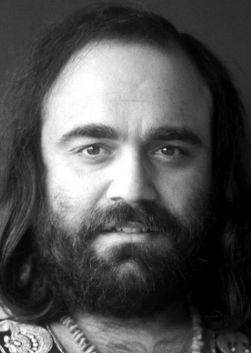
| Full name | Artemios “Demis” Ventouris-Roussos |
| Born | June 15, 1946, Alexandria, Egypt |
| Died | January 25, 2015, Athens, Greece (age 68) |
| Estimated net worth | $3 million – $15 million |
| Albums sold | Over 60 million worldwide |
| Known for | “Forever and Ever,” “Goodbye My Love, Goodbye,” Aphrodite’s Child |
| Genres | Pop, art rock, classical, folk, blues |
Who Was Demis Roussos?
Demis Roussos was one of the most distinctive voices in European pop music — a lyric tenor whose kaftan-clad performances and warm, tremulous vibrato made him a chart phenomenon across the UK, continental Europe, and the Soviet Union simultaneously during the 1970s. Born Artemios Ventouris-Roussos on June 15, 1946, in Alexandria, Egypt, he co-founded the progressive rock band Aphrodite’s Child with Vangelis before launching a solo career that sold over 60 million albums worldwide. He died in Athens on January 25, 2015, from multiple cancers, at age 68.
Demis Roussos Net Worth
Estimates of Demis Roussos’s net worth at the time of his death vary considerably. Most sources place the figure somewhere between $3 million and $15 million, with a handful of celebrity finance sites citing numbers as high as $31 million. No verified estate valuation has been publicly disclosed, making any precise figure hard to confirm.
What the record shows clearly: Roussos sold over 60 million albums globally across a career spanning five decades. His income came from recording royalties, relentless European touring (which he openly described as his primary income stream during the Aphrodite’s Child years, since he wasn’t earning songwriter royalties from other artists), licensing fees, and his contribution to the Blade Runner soundtrack. His catalog continued generating revenue long after his commercial peak in the mid-1970s, particularly in the Soviet and Eastern European markets where his popularity outlasted his profile in the West by years.
Childhood in Alexandria
Roussos grew up in a musical household in one of the Mediterranean’s most cosmopolitan cities. His mother Olga, who had Egyptian and Italian roots, was a professional singer. His father, Greek engineer Yorgos Roussos, played acoustic guitar and kept music running through the home. By his early teens, Demis was playing trumpet, guitar, organ, and double bass — and singing as a soloist in the Greek Orthodox Church choir, absorbing jazz, Arabic, and Greek folk music in roughly equal measure.
The family’s settled life in Egypt fell apart in the wake of the 1956 Suez Crisis. The subsequent years brought rising Egyptian nationalism and mounting pressure on the country’s Greek and other minority communities. By 1961, the Roussos family had effectively been pushed out — they relocated to Greece, their ancestral homeland, and arrived nearly bankrupt. The reception was cold. To help support his family, the teenage Demis found work playing trumpet in jazz ensembles and later bass guitar in a pop band. The discovery of his singing voice came by accident: a vocalist dropped out one night, Roussos stepped to the microphone on impulse, and found something no one had expected to be there.
Aphrodite’s Child: Art Rock in Exile
In 1963, Roussos was performing in an Athenian pop group called The Idols alongside a keyboardist named Evagelos Papathanassiou — who would become known worldwide simply as Vangelis — and drummer Loukas Sideras. When the Greek military junta seized power in April 1967, all three were in Paris and decided not to return. They attempted London — the center of the music world at the time — but without British work permits, they were turned back at the border and found themselves in France permanently.
In Paris, the trio formed Aphrodite’s Child and signed with Mercury Records. Their timing, as ever, was turbulent: the 1968 student uprisings shut down recording sessions just as the debut album was underway. Only one song was finished before the studio closed. That song, Rain and Tears — built on an arrangement of Pachelbel’s 17th-century Canon in D — sold over a million copies across Europe. Most listeners took it for a love song. The band had written it about police tear-gas at the student protests.
The group charted consistently for the next three years, but creative tensions were pulling Roussos and Vangelis in opposite directions. Vangelis was composing for outside artists and earning royalties from record sales regardless of whether the band toured. Roussos, who wasn’t writing for other acts, depended on live performances for income. They reached a working arrangement — Vangelis stayed in the studio, Roussos took a hired keyboardist on the road — but the deeper disagreement surfaced when Vangelis proposed what would become the group’s final album.
666 was Vangelis’s vision: a double LP adapting the Book of Revelation into dense, experimental progressive rock. Roussos and Sideras argued it was too complex, too uncommercial. When the record came out on Vertigo Records in June 1972, the band had already disbanded, and the album sold modestly at first. History has since overturned that verdict. Salvador Dalí and Andy Warhol both praised it enthusiastically. Noel Gallagher of Oasis has cited “The Four Horsemen” as one of his favorite tracks. Porcupine Tree’s Steven Wilson called it “one of the greatest concept albums of all time.” It is now recognized as a landmark of European progressive rock.
Solo Career: The Voice That Conquered a Decade
Roussos had been recording solo material while still with Aphrodite’s Child. His debut album, Fire and Ice (1971), charted at No. 4 in Belgium and No. 9 in the Netherlands — a promising start, though not a breakout. The real shift came with the 1973 album Forever and Ever, which peaked at No. 2 on the UK Albums Chart and topped the charts in Germany, Norway, and the Netherlands. The title track eventually hit No. 1 on the UK Singles Chart in 1976, making Roussos one of the rare European acts to cross from continental stardom into genuine British chart success.
Goodbye My Love, Goodbye — first recorded in German — became the song most people associate with him, even though Forever and Ever outsold it. The contrast with Aphrodite’s Child couldn’t have been starker: instead of experimental art rock, Roussos was offering a warm, open tenor over melodic, uncomplicated pop. Critics were often unkind — “singing tent,” “fat sex symbol in a kaftan” were among the printable descriptions — while audiences across a dozen countries simply disagreed. In 1976, the BBC broadcast the documentary The Roussos Phenomenon, marking how thoroughly he had embedded himself in British popular culture.
His voice’s defining quality had a prosaic origin. A childhood throat illness left his vocal cords only partially healed, producing a tremulous vibrato that couldn’t have been manufactured by training. No critical contempt could make it less arresting on a radio dial.
In the Soviet Union, Roussos was arguably the most popular Western artist of the 1970s. Souvenirs to Souvenirs — a song about memories, not tourist trinkets, despite how the Soviet translation read — was played everywhere. Goodbye My Love, Goodbye reportedly featured in a Soviet animated television series about a parrot named Kesha, and Soviet leader Leonid Brezhnev was said to fall asleep listening to it. Music critic Artemy Troitsky later recalled that the Soviet intelligentsia treated Roussos with mild condescension while the broader public adored him without reservation.
In 1982, Vangelis composed the score for Ridley Scott’s Blade Runner and brought Roussos in to provide vocals for one track: Tales of the Future. Roussos delivered the wordless, Arabic-inflected performance — partly genuine Arabic, partly invented sounds — in the accent of the Alexandria he had left as a teenager. The track plays during the Taffy Lewis club scene featuring the replicant Zhora, though it was not included on the official Blade Runner soundtrack release.
The 1985 Hijacking
On June 14, 1985, Roussos and his third wife, Pamela, were aboard TWA Flight 847 when Hezbollah operatives seized the aircraft shortly after takeoff from Athens. The hijackers demanded the release of 766 Shia Muslim prisoners held in Israeli custody and flew the plane on a harrowing 17-day journey between Beirut and Algiers. U.S. Navy diver Robert Stethem was murdered during the crisis; his body was thrown onto the Beirut airport tarmac.
Roussos was held for five days alongside his wife and other Greek nationals before being released as part of a negotiated arrangement. His celebrity in the Arab world put him in an unusual position among the hostages — one hijacker asked for his autograph, while another asked him to watch over a Kalashnikov while he took a shower. Other hostages recognized him and asked him to sing during the captivity. He reportedly obliged. At the press conference after his release, Roussos sat next to Nabih Berri and told waiting journalists that his captors had been “very polite, very nice to me.”
The experience reshaped him. He lost significant weight in the months that followed and stepped away from mainstream pop. Subsequent recordings ranged across classical arias, ethnic music, Japanese flute arrangements, and a collaboration with the German electronic group Tangerine Dream.
Later Years
In November 1986, Roussos made his first visit to the Soviet Union, appearing on the popular television game show What? Where? When? — a remarkable moment for audiences who had heard him on Soviet radio for over a decade without ever seeing him perform live.
His final studio album, Demis, was released in 2009, recorded in Britain in a blues-rock direction that surprised fans who knew only his kaftan-era work. It was, in its way, a return to the roots of his Alexandria childhood — jazz and rhythm, stripped of the pop gloss that had made him famous.
Personal Life
Roussos was married four times. His first wife, Monica, was the mother of his daughter Emily. His second wife, Dominique, gave him a son named Cyril, who later became a DJ and in the late 1990s released a club remix of Forever and Ever. His third wife, American model Pamela Smith, was beside him during the 1985 hijacking. His fourth and final wife was a Parisian named Marie-Thérèse.
He pushed back against the “women’s favorite” label throughout his career, insisting his songs were addressed to anyone willing to listen, not to any particular audience. In later interviews, he was pointed about the music industry’s shift from artist development to disposable product cycles — the 1970s, he argued, gave musicians time to grow; the early 21st century required an immediately marketable sound, briefly monetized it, then moved on without looking back. He was equally critical of digital communication crowding out genuine human contact.
On Greece’s debt crisis in 2014, he was unambiguous:
“Greece is the scapegoat of a grand scheme concocted by groups of people and banks that rule our planet.”
He named Mozart his favorite composer — “because he was so childishly sensitive” — and reserved particular admiration for Sting, whose songs he felt belonged completely and irreducibly to the person who wrote them.
Death and Legacy
Demis Roussos died on January 25, 2015, at the Ygeia Hospital in Athens, after being diagnosed simultaneously with stomach, pancreatic, and liver cancer. Greek parliamentary elections were held that same day; his family chose to delay announcing his death until January 26 rather than overshadow the vote.
He was 68. Over a career spanning more than five decades, he sold over 60 million records — a figure that places him, critical dismissal notwithstanding, among the best-selling European artists of the 20th century. His work with Aphrodite’s Child influenced progressive rock across the continent. His solo catalog defined the sound of Mediterranean pop for a full generation of listeners across Western Europe, the Middle East, and the Soviet bloc. The voice — shaped by a childhood illness into something impossible to replicate — stays immediately recognizable to anyone who grew up near a radio in the 1970s.
On June 15, 2016 — what would have been his 70th birthday — his children Emily and Cyril opened the Demis Roussos Museum in Nijkerk, the Netherlands.
Frequently Asked Questions
What was Demis Roussos’s net worth when he died?
Estimates range widely, from roughly $3 million to $15 million, with some celebrity finance sites citing figures as high as $31 million. No verified estate valuation has been publicly released. What’s well documented is that he sold over 60 million albums globally over more than 50 years — a catalog that generated royalties long after his commercial peak.
Why was Demis Roussos’s voice so distinctive?
A severe throat illness in childhood left his vocal cords only partially healed, producing an unusual vibrato that no training could have manufactured. Critics occasionally used it against him; audiences found it impossible to ignore on a radio dial.
What happened to Demis Roussos during the 1985 plane hijacking?
He was a passenger on TWA Flight 847, seized by Hezbollah on June 14, 1985. He and his then-wife Pamela were held for five days before being released as part of negotiations over the Greek national hostages. He publicly described his captors as “very polite.”
Did Demis Roussos sing on the Blade Runner soundtrack?
Yes. He provided vocals for “Tales of the Future,” composed by Vangelis for the 1982 Ridley Scott film. The track was used in the movie but was not included on the official Blade Runner soundtrack album.
What band was Demis Roussos in before going solo?
He was a founding member of Aphrodite’s Child, a Paris-based progressive rock group formed with Vangelis and Loukas Sideras. Their biggest hit was “Rain and Tears” (1968); their final album, the double LP 666 (1972), is now considered a classic of European progressive rock.