
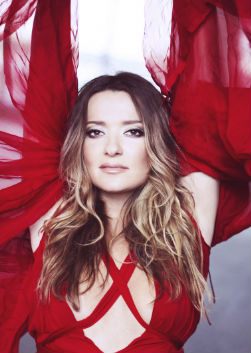
Natalya Mogilevskaya is one of Ukraine’s most recognized pop artists — a singer, actress, television producer, and vocal mentor who has worked in Ukrainian entertainment for more than three decades. Her estimated net worth sits at roughly $1 million to $3 million USD, built from album sales, live touring, television production and judging fees, and commercial work spanning a career that began in Kyiv in the early 1990s.
That figure, drawn from celebrity finance aggregators and media sources, has never been confirmed by Mogilevskaya herself — Ukrainian entertainers rarely disclose exact financials. What her career record makes clear, though, is that the money came from many different directions at once.
Quick Facts
| Full name | Natalya Alekseevna Mogilevskaya (born Mogila) |
| Date of birth | August 2, 1975 |
| Birthplace | Kyiv, Ukraine (then Ukrainian SSR) |
| Profession | Singer, actress, TV producer, vocal teacher |
| State honor | People’s Artist of Ukraine (2004) |
| Estimated net worth | $1–3 million USD (estimated) |
Early Life and Family
Natalya was not, by her teachers’ accounts, an easy student. Growing up in Soviet-era Kyiv, she found the system’s insistence on conformity genuinely suffocating — her creative streak clashed openly with teachers who wanted every child treated identically. At one point, the school administration sent a formal delegation to her parents asking them to keep Natasha from influencing other students. Her parents, to their considerable credit, did not comply.
Her father, Alexei Mogila, worked as a production manager and notably was not a member of the Communist Party — a deliberate choice that said something about the family’s independent outlook. Her mother, Nina Petrovna, worked at the restaurant of Kyiv’s Intourist Hotel, at the time one of the only establishments in the city that regularly hosted foreign visitors. Both parents gave Natalya wide creative latitude, and she later credited that freedom as foundational to how she built her career.
At 16, she finished her nine-year schooling and enrolled in a local circus variety school, moving into her own rented apartment at the same time. It was the early 1990s — the Soviet Union was collapsing, the economy was in chaos — and her parents worried, but they let her go. Her father died while she was still young; her mother, Nina Petrovna, passed away in 2013. She has a sister, Oksana, with whom she has remained close throughout her adult life.
Music Career
Finding Her Footing (1990–1996)
She didn’t walk straight from school into a record deal. Starting in 1990, Mogilevskaya worked her way up through Kyiv’s live performance circuit: solo work at the Rodina Folklore Theater, performances at the Kyiv Variety Theater and the Kyiv Circus Orchestra, and backing vocal work for Russian pop singer Sergei Penkin. Songs like “A Girl with Lily-Colored Hair,” “Snowdrop,” and “Jerusalem” — the latter written specifically for her by acclaimed Ukrainian poet Yuri Rybchinsky — built a local following before she had a record to her name.
The real catalyst came in 1995, when she won at the Slavianski Bazaar international festival in Vitebsk — one of the most prestigious pop competitions in the post-Soviet world. The win gave her the industry credibility to pursue a proper solo career. She started attending the Kyiv National University of Culture and Arts while recording her earliest professional tracks.
Debut and Chart Success (1997–2003)
Her 1997 debut album, “La-la-la,” found an immediate audience across Ukraine. Two years later, “Month” — the lead single from the follow-up album “Only I” — was named Song of the Year in Ukraine, and Mogilevskaya took home the best female singer award. She defended that title again with her fourth studio album, “Not Like That,” released around 2001.
People’s Artist and Peak TV Exposure (2004–2010)
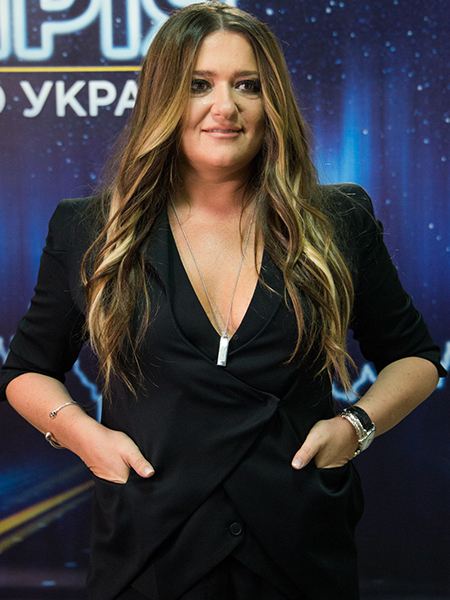
In 2004, Mogilevskaya received the title of People’s Artist of Ukraine — a state honor that sits at the top of the Ukrainian government’s arts recognition system. She also became the host and producer of the television show Chance that same year, marking the start of her behind-the-scenes career in television.
The next few years were relentlessly active. She collaborated with Russian pop star Philip Kirkorov on the video “I’ll Tell You Wow!..,” released the Ukrainian-language album “Vidrula message,” and placed second on Dancing with the Stars Ukraine alongside professional dancer Vlad Yama — their performance in a dramatic black gown with deep cutouts becoming one of the show’s most talked-about moments. She won first place on Star Duet the same cycle. In 2007 and 2008, Viva! magazine named her Ukraine’s most beautiful woman; she released three albums across those two years, toured nationally with Yama, and produced Star Factory-2, the Ukrainian adaptation of the international talent competition format.
In 2009, she joined a nationwide tour supporting Yulia Tymoshenko’s presidential campaign — one of the more visible political acts of her public career up to that point.
Judging, Mentoring, and New Singles (2010–2017)
From 2010 through 2015, her center of gravity shifted toward television judging. She appeared as a jury member on Star Factory: Superfinal, Dancing with the Stars, and Voice. Children, while continuing to release new singles — “Hug, Cry, Kiss,” “I Got Wound Up,” and “Lose Weight” among them.
In September 2017, she released “I Danced,” and by late October had won that season of Dancing with the Stars with partner Igor Kuzmenko. She followed that immediately by joining the fourth season of Voice. Children as a mentor and jury member, sharing the panel with Dmitry Monatik and the pop duo Nadia Dorofeeva and Alexei Zavgorodniy from “Time and Glass.”
Film and Television Roles
Mogilevskaya’s acting work has been secondary to her music career, but consistent across the years:
- 1998 — Take the Overcoat…: A film featuring several prominent Ukrainian pop singers, loosely inspired by Leonid Bykov’s wartime classic Only Old Men Go Into Battle.
- 2003 — The Snow Queen: A musical film produced by composer Igor Krutoy and director Maxim Papernik.
- 2007 — Hold Me Tight: A melodramatic TV series in which she played singer Olga Tumanova, with her own songs featured throughout the soundtrack.
- 2007 — A Very New Year’s Movie, or Night at the Museum: A musical comedy film.
- 2014 — Kyiv Cake: A comedy in which she appeared in a small supporting role.
Personal Life
Mogilevskaya has been unusually candid about her relationships, particularly by the standards of Ukrainian celebrity culture.
In August 2004, she married businessman Dmitry Chaly after roughly two years of dating — mostly weekends, never full cohabitation. It fell apart within months of the wedding. She later said they had essentially never lived together before and didn’t realize how different that would be. Her mother and older sister had both warned her against it. She proceeded anyway.
From 2006, she was with businessman Yegor Dolinin. She took on a stepmother role to his three daughters from a previous marriage — Vasilisa, Varvara, and Veronika — and by her own description treated them as her own. They met because Vasilisa had asked her father to take her to a nightclub, and Mogilevskaya happened to be there the same evening. The relationship lasted five years. They separated in 2011, with Dolinin’s difficulty accepting the demands of her entertainment schedule cited as the central factor. The split remained amicable.
By May 2017, she was in a new relationship, which she described only briefly in the press. She declined to identify the man: “He is a yogi,” she said, and left it at that. That same year, she attracted significant media attention for losing 25 kg through a sustained dietary change — a transformation she discussed openly in Ukrainian interviews.
Natalya Mogilevskaya Net Worth: The Full Picture
Celebrity finance aggregator sites estimate Mogilevskaya’s net worth at $1 million to $3 million USD. No official figure exists — she has not disclosed her personal finances publicly — so any specific number should be treated as an informed estimate based on career earnings and the Ukrainian entertainment market.
Her income has flowed from several distinct sources over the decades:
- Album sales and streaming: More than a dozen studio albums released from 1997 onward, with strong domestic sales during Ukraine’s commercial pop boom in the 2000s. Streaming now provides a smaller but ongoing revenue stream.
- Live performances and touring: Multiple major national tours, particularly concentrated between 2005 and 2010. Concert fees for an artist of her profile in the Ukrainian market are substantial.
- Television production: Producing fees from Chance (2004) and Star Factory-2 represent above-the-line earnings that go well beyond what a performing artist typically receives.
- Judging and mentoring: Long-running paid roles on Dancing with the Stars, Star Factory: Superfinal, and Voice. Children.
- Commercial and endorsement work: As one of Ukraine’s most recognizable female entertainers through the 2000s and 2010s, she has appeared in advertising campaigns, though specific contract values have never been disclosed.
- Vocal teaching and mentorship: A steady secondary income stream woven throughout her career.
The People’s Artist of Ukraine title carries real cultural prestige and certain state privileges, but it does not come with direct financial compensation. The wealth she’s accumulated reflects more than 30 years of consistent work across multiple entertainment verticals — none of it a single windfall, all of it earned steadily.
Frequently Asked Questions
What is Natalya Mogilevskaya’s real last name?
She was born Natalya Mogila. She adopted the stage surname Mogilevskaya early in her professional career.
When did Natalya Mogilevskaya receive the People’s Artist title?
She received the title of People’s Artist of Ukraine in 2004 — the same year she became the host and producer of the television show Chance.
Did Natalya Mogilevskaya ever represent Ukraine at Eurovision?
No. Despite her prominence in Ukrainian pop music, she has not competed at the Eurovision Song Contest as Ukraine’s national entry.
Does Natalya Mogilevskaya have children?
She has no biological children. During her relationship with Yegor Dolinin from 2006 to 2011, she took on a stepmother role to his three daughters — Vasilisa, Varvara, and Veronika.
How did Natalya Mogilevskaya lose 25 kg?
In 2017, she lost approximately 25 kg through a sustained dietary change. She has spoken about the process in Ukrainian media but has not endorsed any specific commercial diet program.
What is Natalya Mogilevskaya known for internationally?
Outside Ukraine, she is best known as a prominent figure in the post-Soviet pop scene, for winning the Slavianski Bazaar festival in 1995, and for her long career as both a performer and television personality in Ukrainian entertainment.